

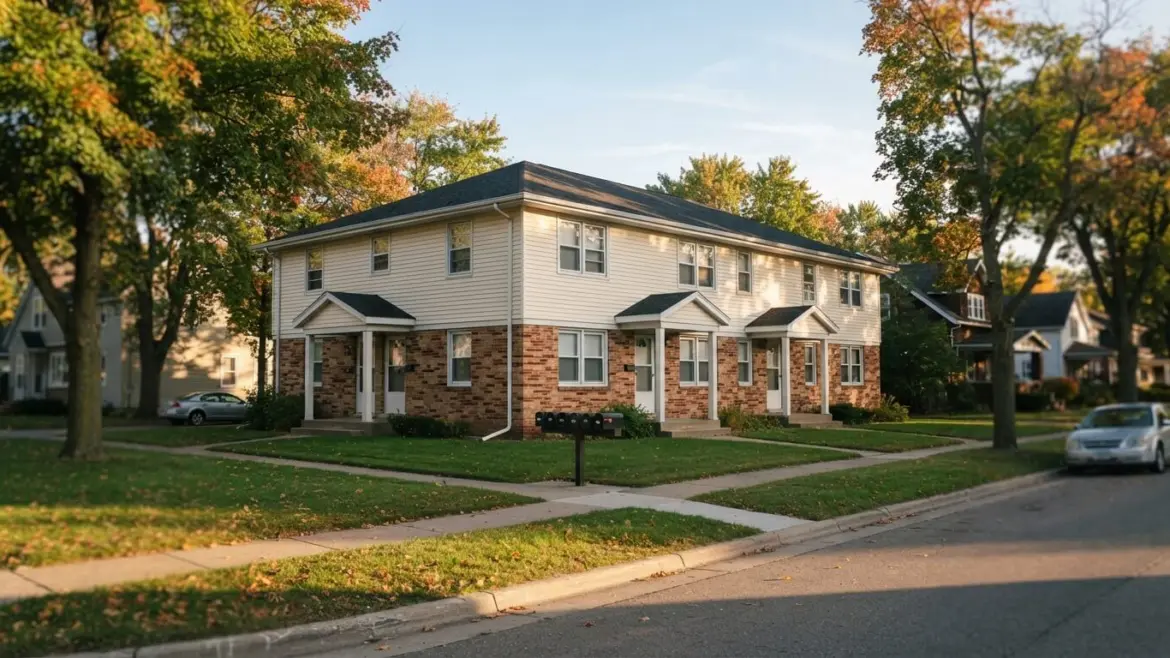
Most Michigan landlords learn what their policy actually covers on the worst possible day. A pipe freezes in a unit that has been empty since November. A tenant slips on a walkway nobody salted. A fire damages half a duplex built in 1958, and the rebuild has to meet current code. The claim gets paid, but it does not cover everything, and the difference comes out of the owner’s pocket.
Rental and commercial property has gotten more expensive to insure across Michigan. Reinsurance costs, construction and labor pricing, and the age of the housing stock in Rochester, Rochester Hills, and the rest of Metro Detroit have all pushed premiums up. A lot of owners have responded by shopping for a lower number, and that is exactly how coverage gaps get created. A cheaper premium usually means a narrower policy form.
Here are six places where landlord insurance in Michigan tends to fall short, and what to ask your agent about each one.
1. Does your policy pay rebuild cost or depreciated value?
This is the single most expensive difference between two policies that look similar on a quote sheet.
An actual cash value policy pays replacement cost minus depreciation. A replacement cost policy pays what it takes to rebuild today. On a 20-year-old roof, that gap can be most of the roof. Basic dwelling forms (DP-1) typically settle on actual cash value and cover a short list of named perils. A DP-3 form covers a broader range of causes of loss and generally settles at replacement cost.
Owners who bought a rental in 2015 and have not looked at the declarations page since are often still carrying the limit that matched 2015 construction pricing. Ask two questions: which settlement basis is on the policy, and what the current limit would actually rebuild.
2. Code upgrades after a loss are usually not covered by default
A standard property policy pays to rebuild what was there. It does not automatically pay to bring the rest of the building up to current code, and Michigan’s code picture changed recently.
The 2021 Michigan Building Code and the 2021 Michigan Rehabilitation Code for Existing Buildings took effect April 9, 2025, and the 2021 Michigan Commercial Energy Code took effect April 22, 2025. The residential code update was paused by a court order, so single-family and small residential work still follows the 2015 code. Current adoptions are published by the LARA Bureau of Construction Codes.
The practical consequence is straightforward. If a covered loss damages enough of an older commercial or mixed-use building, the repair has to meet current code, and the added cost can run well past what the policy pays for the damage itself. Ordinance or law coverage is the endorsement that handles it. On pre-1980 buildings, which describes a lot of downtown Rochester and much of the older commercial building stock in Oakland County, it is worth asking about by name.
3. The vacancy clock runs faster than most owners expect
Most landlord and commercial property policies limit or suspend coverage once a building has been vacant for 30 to 60 days. Vandalism, water damage, and glass breakage are commonly the first things excluded, and a fire loss can be reduced.
Michigan turnover makes this a real risk rather than a technicality. A unit that empties in late October and does not lease until spring crosses the vacancy threshold in the exact window when frozen pipe claims peak. A renovation between tenants does the same thing. Vacant property insurance, or a vacancy permit endorsement on the existing policy, keeps the coverage in force. It has to be added before the property sits empty, not after the claim.
4. Lost rent is separate coverage, and it has a time limit
If a covered loss makes a unit uninhabitable, the building gets repaired and the rent stops. Fair rental value or loss of rents coverage replaces that income, but it is a distinct coverage part with its own limit and its own duration, often 12 months.
Two things to check. First, whether the limit reflects current rent rather than what the unit rented for when the policy was written. Second, whether the duration is realistic. Contractor availability in Southeast Michigan has stretched repair timelines, and a 12-month limit on a rebuild that takes 16 months leaves four months of carrying costs uncovered.
5. Tenant injury claims changed in Michigan in 2023
For decades, Michigan property owners had a strong defense against slip-and-fall claims. If a hazard was open and obvious, meaning a reasonable person would have seen it, the case was usually dismissed before trial.
That changed with the Michigan Supreme Court’s decision in Kandil-Elsayed v. F & E Oilpolicies. Whether a hazard was obvious is no longer an automatic defense. It is now a question of comparative fault for a jury, alongside whether the owner took reasonable care. The underlying case involved a slip on snow-covered ice, which tells you how relevant it is here.
Document your maintenance. Inspection notes, salting and snow removal records, and written contracts with your snow vendor including indemnification language all matter more than they did three years ago.
Then look hard at your liability limit. A $500,000 underlying limit with a commercial umbrella above it is common practice for owners with more than one property. Umbrella insurance for rental property is one of the least expensive coverages relative to what it does, and most owners who add one are surprised by the cost.
6. Short-term rentals are usually excluded
Standard landlord and homeowners policies generally exclude transient commercial use. If a property is listed on Airbnb, VRBO, or a similar platform, even occasionally, the policy may not respond to a claim that happens during a paid stay.
Platform-provided protection is not a substitute for your own policy, and it typically does not cover the building the way a property policy does. If you rent short-term, get written confirmation that your policy covers it or add a short-term rental endorsement. This is also worth checking if a long-term tenant is subletting the unit on a platform without telling you.
What to review before the first hard freeze
- Pull the declarations page and confirm the settlement basis and the building limit
- Ask whether ordinance or law coverage is on the policy and at what limit
- Flag any unit that will be empty for more than 30 days this winter
- Compare the loss of rents limit to what the property actually rents for now
- Check the liability limit and whether an umbrella sits above it
- Confirm written snow removal contracts are in place for every property
- Verify short-term rental use is disclosed and covered
- Require renters insurance in your leases, commonly $100,000 in tenant liability
Talk Through Your Property Coverage
If you own rental or commercial property in Rochester, Rochester Hills, or anywhere in Southeast Michigan, a policy review is a short conversation that usually surfaces at least one of these gaps. Marcus Schirr Insurance Group works with property owners across the area to compare what is on the current policy against what the property actually needs.
Contact Marcus Schirr Insurance Group or call 248.464.8749.